AI for Retail and Food

Find practical AI examples for Indian shops and food businesses. Make product questions, delivery enquiries and customer follow-up easier to manage.

Friendly AzentiKo assistant waving hello

A useful starting point for Indian businesses

Where Can AI Help Your Team?

AI helps commerce teams understand customer questions, organise product information and support shoppers. It can suggest useful next steps, but prices, stock, delivery and refunds must come from trusted systems and people.

Indian shoppers use many languages, local phrases and different buying habits. Commerce teams use AI to understand intent, improve product discovery and answer common questions. These examples show practical patterns for stores and marketplaces. They do not mean that AzentiKo has a connection with any company listed here.

Explore Live Demo Options
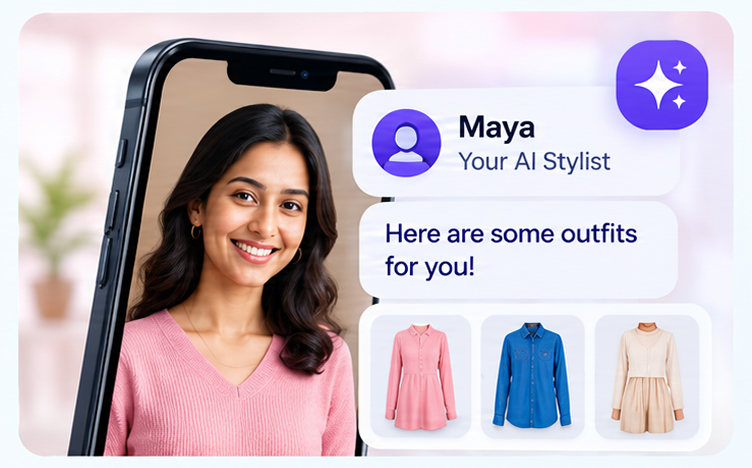
Illustrative fashion and product-help workflow
Illustrative industry artwork from our local assets. Not a customer deployment or proof of a product feature.

Learn from published work and clear ideas

Company Examples, Explained Simply

These names come from the supplied Indian enterprise reference. Published examples link to official company, technology-provider or public-service sources. Unconfirmed claims are labelled separately. None is an AzentiKo customer, partner or endorsement.

Reviewed . A historical publication does not confirm a service’s current availability or performance.

Swiggy logo

Swiggy

Published AI example

Swiggy has described neural search that accepts open-ended food and grocery requests, including conversational preferences. It also discussed generative AI for restaurant discovery and partner self-service. The company describes these as its own product work, not as a general claim about every food business.

What a Smaller Business Can Learn

Use plain customer language as a starting point, then show a small set of relevant choices. Keep the catalogue and local availability current, and provide a clear hand-off when the request is unclear.

Official Swiggy engineering/product article; not an AzentiKo integration.

Swiggy’s Generative AI Journey (opens in a new tab)
Zomato logo

Zomato

Published AI example

Zomato’s February 2025 investor update introduced Nugget as an AI-native customer-support platform built first for its own teams. The update describes its use across Zomato, Blinkit and Hyperpure. This is a documented support example, not proof of the order-prediction architecture in the supplied reference.

What a Smaller Business Can Learn

Describe the customer task and data use plainly. Keep recommendations helpful, but do not turn a prediction into a promise about availability, delivery or price.

Official company disclosure. No automation percentage, volume figure or AzentiKo relationship is implied.

Zomato investor update introducing Nugget, February 2025 (opens in a new tab)
Flipkart logo

Flipkart

Published AI example

Flipkart has published that its semantic search supports text and visual search, and has described its Flippi chat assistant and generative AI shopping work. The published examples focus on helping shoppers express intent and discover products across a large catalogue.

What a Smaller Business Can Learn

Let customers describe a product in their own words or share a reference image. Use product facts for the final answer; do not let generated copy replace stock, price or return-policy data.

Official Flipkart Stories interview; not an AzentiKo customer or partner.

GenAI to redefine Indian e-commerce: Q&A (opens in a new tab)
Myntra logo

Myntra

Published AI example

Microsoft’s official customer story describes Myntra’s MyFashionGPT, powered by Azure OpenAI and ChatGPT 3.5, alongside MyStylist and Maya. The tools help shoppers search with natural language and move from broad fashion questions to more focused choices. This verifies the use pattern, not the attachment’s unverified sales wording.

What a Smaller Business Can Learn

Ask about occasion, budget, size and colour, then show understandable reasons for suggestions. Keep product facts and stock in trusted systems.

Official Microsoft customer story; not an AzentiKo customer or partner.

Myntra: Creating a new interaction paradigm (opens in a new tab)

Zepto

Industry idea — AI claim not confirmed

Zepto is included as a quick-commerce industry reference. The specific Zap assistant, visual return-scoring system and automation percentage described in the supplied note have not been confirmed through an official source in this review.

What a Smaller Business Can Learn

For delivery claims, collect order ID, item and reason first. Route refunds and image-based checks to approved business rules and people until accuracy is measured.

Industry reference only. The company homepage is not evidence of the specific AI claim.

Zepto official site (opens in a new tab)

Ideas you can plan with your team

Start With Everyday Customer Questions

These are illustrative workflows, not verified AzentiKo capabilities or measured customer results. Confirm the feature, data access and connection before implementing one.

Product questions

A clothing shop assistant answers size, colour, material and exchange questions from an approved catalogue, then sends unusual requests to the store team.

A customer may ask
Which size should I choose for this shirt?

Order support

A small online store collects the order number and issue, explains the published delivery policy and routes delayed or damaged orders to a person.

A customer may ask
Where is my order and what should I do if it is late?

Lead capture

A furniture seller asks about room size, budget and delivery city, records the enquiry and alerts sales staff to call back with real availability.

A customer may ask
Can you suggest a table for my space and budget?

A Practical Business Scenario

A local fashion store could start with a small customer assistant trained on its catalogue, delivery areas, exchange rules and store timings. It can answer repeated questions, collect a product request and pass uncertain cases to a person. Keep prices, stock and order status connected to trusted systems before allowing the assistant to make a firm promise.

A small, sensible first step

Plan It. Test It. Then Decide.

Make the first workflow easy to check. Keep one person responsible for the information and the next action.

  1. Choose one question

    Start with one repeated customer question and define the correct answer in plain language.

  2. Prepare trusted content

    Add current product, delivery, exchange and contact information. Remove old offers and stock statements.

  3. Set safe hand-offs

    Send payment, refund, complaint and unclear cases to a trained person with the conversation context.

  4. Test real wording

    Try English, Indian English, short messages and spelling variations before sharing the assistant publicly.

  5. Review weekly

    Check unanswered questions, wrong answers and escalations; update content before expanding the scope.

Keep the Limits Clear

AzentiKo is not a stock, payment, refund or delivery decision engine. Confirm the actual data connection, permissions and operational process before making a customer promise.

Recommendations and conversational search can be wrong when catalogue data, stock or customer preferences are incomplete. Keep a human review path for refunds, payments, allergies and other high-impact decisions.

Check AzentiKo Features and LimitsPlan Your Data Connections

Common Questions Before You Start

Can AI confirm stock?

Only when it is connected to a trusted, current stock system. Otherwise it should say that availability needs confirmation rather than guessing.

Can it process refunds?

It can explain the published process and collect details. A refund decision should remain inside your approved payment or order system.

Will it replace shop staff?

It can reduce repeated questions, while staff handle exceptions, complaints, sensitive cases and decisions that need judgement.

What should I measure?

Track answered questions, hand-offs, correction requests and customer feedback. Do not measure success only by the number of automated replies.

Your next step

Bring Your Questions.
See What Could Work for Your Business.

Explore the examples or request a guided walkthrough. Our team can help you check the plan, setup and tools you need.

A demo request opens your email app. Your team and ours will agree the next steps.